On this edition of Stroke Visionaries, we sit down with Dr. Melanie Winningham, the VP of Clinical Strategy & Partnerships at Sevaro, Stroke Medical Director at Centra Health in Lynchburg, Virginia, and Vascular Neurologist at Sentara Health in Charlottesville, Virginia. With dual roles in both hospital-based stroke leadership and virtual neurology, Dr. Winningham brings a rare, systems-level view of how stroke care works at the bedside and across networks, giving her a uniquely practical lens on how to build scalable, equitable stroke systems.
She holds a bilingual MD from Ponce Health Sciences University in Puerto Rico, completed both her Neurology residency & Vascular Neurology fellowship at Emory University School of Medicine in Atlanta, and in her free time (though she is a very busy woman) she loves to relax, kayak, and enjoy the beautiful scenery of Charlottesville, Virginia. In this conversation, she shares her journey into stroke medicine, the challenges and rewards of U.S. stroke care, advice for women entering vascular neurology, her vision for a virtual, predictive, connected future, and much more.
Q: What first drew you to stroke medicine?
A: From the earliest parts of my medical training, I was drawn to stroke neurology because it offered something rare: the ability to change the trajectory of someone’s life within minutes. Stroke care has shown me how powerful emergent treatments can be - how the right decision at the right second can prevent lifelong disability, restore function, and give people back their independence, their relationships, and their future.
I loved the way that stroke neurology sits at the intersection of urgency, precision, and possibility. There are very few areas in medicine where you can so clearly see the impact of your choices – an arm that begins to function again, the speech that slowly returns, the patient who walks out of the hospital days after being completely paralyzed. Those moments stay with you forever.
That promise of expeditious, meaningful change is what attracted me to vascular neurology. Over time, I became equally passionate about improving systems of care so those outcomes could be achieved everywhere, not just in well-resourced centers. That’s ultimately what led me to Sevaro - a place where we could scale fast, human-centered neurological care to hospitals across the country and transform what’s possible for stroke patients every day.
Q: What are some of the greatest challenges and rewards of working in stroke care in the U.S.?
A: The greatest challenge in stroke care is variation. Geography shouldn’t determine outcomes, yet hospitals across the U.S. have vastly different levels of access to neurologists, imaging expertise, and streamlined workflows. Many teams operate heroically within broken systems, and that creates burnout, delays, and missed opportunities.
The benefits of working in this field are equally powerful. Stroke brings out the best of medicine: true teamwork, evidence-driven protocols, and the chance to change someone’s entire life within minutes. There is no greater privilege than watching a patient who couldn’t speak an hour ago communicate with their family again.
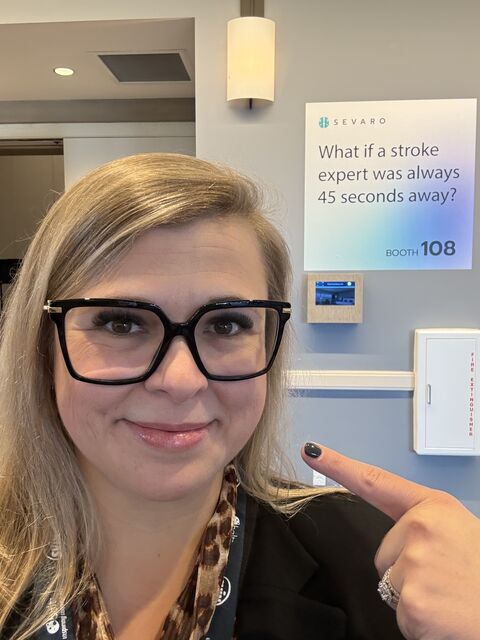
Working on the virtual neurology side, I see daily proof that we can remove barriers – through 45-second connections with stroke experts, seamless large vessel occlusion (LVO) workflows, AI triage, and entire hospital systems transformed through deep clinical partnerships. Stroke care is challenging, but it’s also where innovation makes the most immediate and measurable impact.
Q: What advice would you give to women entering the field of vascular neurology?
A: Don’t wait to “earn” your voice. Use it from day one.
Stroke medicine moves fast, and diverse perspectives make teams stronger. You belong in the room where decisions are made, whether that’s bedside rounds, quality committees, or corporate boardrooms.
I’ve learned that you can be both deeply clinical and deeply strategic. My role spans quality oversight, provider development, hospital partnerships, and clinical strategy. Balancing those things requires clarity of purpose: every meeting, every metric, every contract must ultimately connect back to better care for stroke patients.
My advice is to build relationships early - mentors, sponsors, and champions truly matter.
Say yes to rooms that feel intimidating; you’ll grow into them faster than you think. Protect your clinical confidence, because it’s your north star even when you’re wearing your corporate hat. And above all, lead with service. When your work is rooted in caring for patients and communities, it becomes much easier to navigate both the clinical and corporate sides of the role.
Q: How do you see the future of stroke medicine evolving?
A: The future of stroke medicine is virtual, predictive, connected, and radically faster.
I envision a future where AI serves as an intelligent early-warning system - flagging concerning patterns and imaging findings sooner and helping teams act before symptoms escalate. Virtual neurologists will respond instantly, with no call centers or delays, and every hospital - including those in rural or resource-limited areas - will have seamless access to expert care.
Quality improvement will be real-time, powered by dashboards that identify opportunities within minutes instead of months.
Stroke care will become proactive, personalized, and continuous - shifting from episodic emergencies to a connected system that supports patients throughout their care journey: from ambulance to ambulatory care. Most importantly, the future will be built through partnerships: clinicians, engineers, hospitals, and innovators working together to close the gap between what stroke care is today and what it should be.
At Sevaro, we like to say we’re “building the future of virtual neurosciences.” To me, that future is simple: fast, equitable, human-centered stroke care for every patient, everywhere.
If you or someone you know is driving change in stroke care, we’d love to hear from you. Please send an email with your nomination to Emma Houtz at ehoutz@brainomix.com.
Stay tuned for more editions of Stroke Visionaries.